
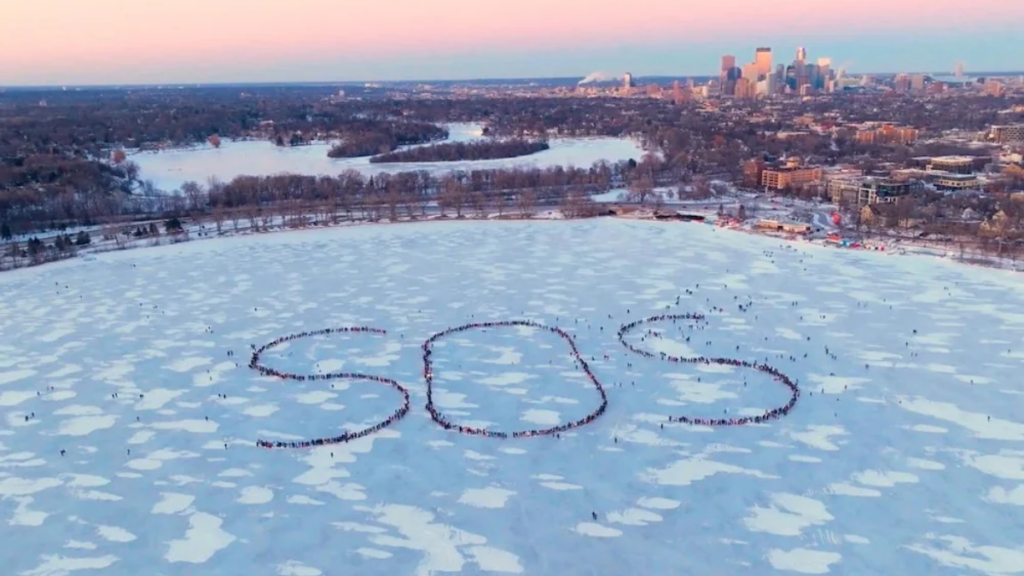
One image from the film keeps getting mistaken for a fake. It shows hundreds of people standing on a frozen Minneapolis lake at night, their lights spelling out “SOS.”
A friend of producer Brian Lucas assumed a computer had made it. Lucas corrected him: “that’s not AI, that’s people.” They were standing outside in temperatures he puts at 25 below.
That picture is now the poster for “A Month in Minnesota,” a short documentary about how residents of the Twin Cities reacted when federal immigration agents arrived in force last winter.
What the film is
The documentary runs 39 minutes and is directed by Annie Sundberg, with Lucas and Sundberg as producers. Sundberg’s earlier films include “The Trials of Darryl Hunt” and “The Devil Came on Horseback.”
The Twin Cities Film Fest describes it as starting from the fatal shootings in Minneapolis by ICE agents and widening out to the response from ordinary people across the state. Gov. Tim Walz and Minneapolis Mayor Jacob Frey both appear.
The film has a clear point of view. It is told from the side of residents who opposed the operation, and it presents their actions as a defence of their neighbours.
Two friends and a text message
Sundberg and Lucas have known each other since they were about 12. Everyone who worked on the film is from Minnesota, they say.
Sundberg had been hearing about the mood in the state from a relative. Her niece, who is Korean American and has two small children, had told her in December that she no longer liked going to the grocery store, out of fear of being stopped and asked for papers.
Then came Jan. 7, the day Renee Good was killed. Sundberg watched the news coverage alongside a press conference by Kristi Noem, where allegations of terrorism were made. She says the two accounts did not match, and she texted Lucas that night.
Lucas still lives in Minnesota. He says working on the film gave him something more useful to do than scrolling through bad news. His aim, borrowing a line associated with Mister Rogers, was to look for the helpers.
A film with no main character
Sundberg’s first plan was a conventional one: follow the governor’s or mayor’s team, one activist and one vulnerable family. She dropped it quickly.
What she found, she says, was a network with no single leader. People heard a specific request and said yes. The film reflects that with many short portraits. Among them:
- A couple who went to the Whipple federal building, the regional ICE detention site, and tracked agents’ movements
- An older woman who bought 36 bags of rice for families afraid to leave home
- A nurse midwife who visited pregnant women in their houses
- A song leader who organised people to sing at protests
- Two teenage brothers, then 15 and 17, whose footage often came from scenes before news crews arrived
Lucas calls the result a mosaic. Leaving any of those voices out, he argues, would have given an incomplete picture.
Why the city did not erupt
Sundberg says she went in with one question. After two residents were shot dead in daylight, why was there no repeat of 2020?
Her answer is that people held back on purpose. Many believed that unrest would hand the federal government a reason to send more forces. She also says the neighbourhood networks built after George Floyd’s killing gave people a way to organise without a leader.
Some of those she interviewed told her they felt abandoned by state and local government, whose options were limited.
She points to one decision by Walz. He deployed the National Guard, but its members did not wear masks. According to Sundberg, they handed out coffee, hot chocolate and doughnuts to protesters outside Whipple.
The two deaths
The film includes the deaths of Renee Good and Alex Pretti. Sundberg says many viewers outside Minnesota did not fully understand how they happened.
Lucas describes the Pretti shooting as the moment he feared the city would boil over. It came the day after a large protest. He says federal officials described Pretti as a domestic terrorist, while locals believed he had been helping a woman who was pushed to the ground. When the city stayed calm that day, Lucas says, he knew it would stay calm.
Federal officials have given a different account of both shootings from the one the film presents.
How audiences have reacted
The filmmakers finished in September and have been on the festival circuit since. By their account:
- The film premiered at the Woodstock Film Festival.
- It won an audience award at the Chicago International Film Festival.
- At the Twin Cities Film Fest, three screenings sold out and it won an audience award there as well.
It has also screened in the Hamptons and in Washington, D.C.
The team is now campaigning for an Oscar nomination for best documentary short. Sundberg jokes that finishing a film in September is not how she would advise anyone to start an awards run.
Lucas says some local viewers told him they had pushed the period out of their minds and needed reminding it had happened. Sundberg remembers a woman in tears after the first Twin Cities screening who said she felt very angry and very good at once. That mix, Sundberg says, is what they hoped for.
Light and dark
Both filmmakers return to the same idea. The film has protests staged as celebrations, with lanterns on a frozen lake and a giant monarch butterfly puppet in the closing scene. It also has fear, hiding and two deaths.
Lucas argues that neither half makes sense without the other.

Ethel L. Marini is a writer and editor covering Minneapolis and the wider Minnesota area. She reports on local news and crime stories, and reviews every article before publishing to keep the reporting clear, accurate, and easy for readers to follow.